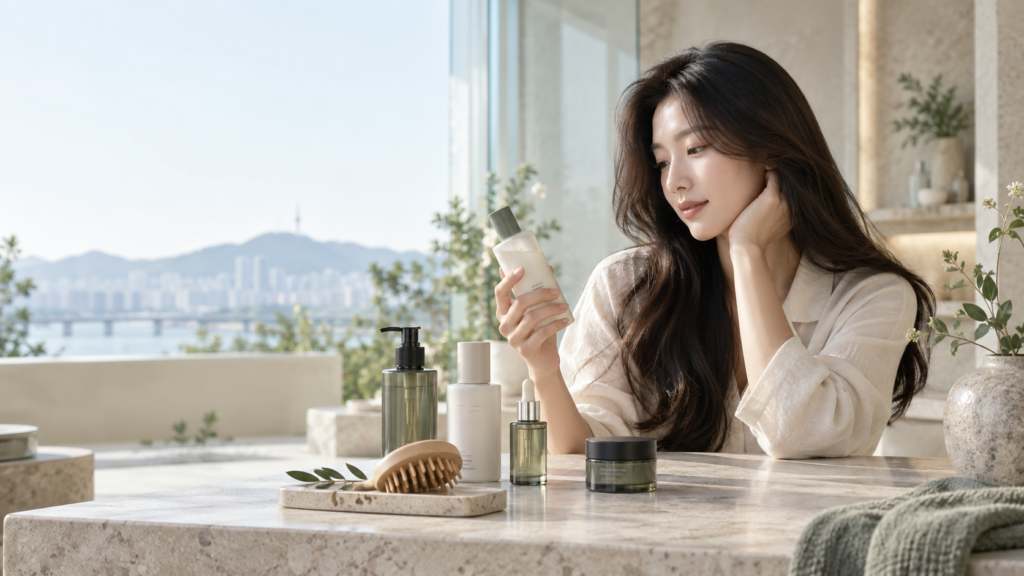
You wash your hair, get that fresh-root feeling, and by tomorrow your part already looks shiny. Meanwhile, your ends still feel like straw. Buying a shampoo labeled “for oily hair” can make the lengths feel worse; grabbing a rich “repair” formula can leave the roots flat. Before you buy a fifth bottle, figure out which part of the routine is actually letting you down.
Quick reality check: oily roots and dry ends are two different shopping jobs. Your shampoo needs to make sense for your scalp. Conditioner and leave-in care need to make sense for your lengths.
| What you notice after 24 hours | Check first | Product direction to compare |
|---|---|---|
| Roots look slick, ends feel fine | How often you wash and whether scalp products build up | A scalp-focused cleanser |
| Roots look slick, ends feel rough | Where shampoo and conditioner go | Scalp cleanser plus length-focused conditioner |
| Hair feels heavy right after drying | Rich masks, oils or leave-ins near the roots | A lighter routine at the scalp |
| Scalp stings, flakes heavily or becomes painful | Discomfort beyond ordinary oiliness | Professional assessment rather than another blind purchase |
First, stop treating your scalp and ends as one hair type
Your roots can get oily while your lengths need more slip and conditioning. That’s why one “oily hair” label rarely tells the whole story. The American Academy of Dermatology suggests adjusting wash frequency to how oily your scalp gets and applying shampoo mainly to the scalp. It also advises conditioner for the hair, with placement depending on hair type. See the dermatologist guidance.
For your next wash, do a quick split test: work shampoo through the scalp, rinse, and put conditioner where the hair feels rough. If your hair is fine or easily weighed down, start at the mid-lengths and ends rather than coating the roots. If your hair is curly or very dry, your conditioning needs may be different—follow how your hair responds instead of a one-size-fits-all rule.
The 24-hour root check: four things to notice
1. When does the oil show up?
Is your part shiny by bedtime, the following morning, or only after a workout? The timing helps you compare your current wash schedule with the results you actually want. Washing an oily scalp daily can be reasonable for some hair types; forcing a longer gap isn’t a badge of honor.
2. Does your hair feel heavy immediately?
If your roots look flat as soon as they dry, look at what’s touching them. A rich conditioner, leave-in, oil or styling cream near the part can change how clean the hair looks. Move one product away from the roots for a few washes before replacing everything.
3. Are you washing the lengths too aggressively?
Shampoo belongs primarily at the scalp. Let the rinse run through your lengths instead of scrubbing fragile ends as if they produce oil, too. For conditioner or a leave-in, start with a small amount where your hair feels dry. Dermatologists recommend keeping leave-in conditioner from mid-strands to ends rather than on the scalp. Read their leave-in tips.
4. Is the issue actually scalp discomfort?
Oiliness alone is one thing. Persistent redness, pain, significant flaking or sudden shedding is a different conversation. Don’t expect a viral Korean shampoo or a matching quiz to diagnose it; get medical advice if those symptoms persist.
How to shop Korean hair care without buying the same mistake twice
Start with your scalp profile, then add your hair condition and desired finish. An oily scalp with fine, flat hair may call for a different comparison than an oily scalp with bleached, rough lengths. The words “scalp scaling,” “volume,” and “damage care” describe different product directions; none guarantees that the product will fit you personally.
Want a starting point in about 30 seconds? Try the K-GORUDA Hair & Scalp Matching Quiz. Answer four questions about your scalp, concern, hair type and desired result, then compare the suggested options and their product details before shopping.
If you want named product directions rather than a routine check, read our Korean shampoo comparison for oily scalp and dry ends. For the longer explanation of why this combination happens, see our greasy-roots-and-dry-ends guide. Neither article is a hands-on product test; check the current formula and retailer terms yourself.
Try one change at the next wash
Pick one variable: scalp wash frequency, conditioner placement, or the amount of leave-in near your roots. Keep the rest of your routine steady long enough to notice what changed. That’s a lot more useful than ordering another entire lineup because somebody’s “holy grail” looked good on camera.
When you’re ready to compare Korean products for your own scalp and lengths, start the K-GORUDA Matching Quiz. Use the recommendations as a shortlist, then verify the exact ingredients, price and shipping in your region.
If your roots get oily but lightweight products still seem to sit on your strands, hair porosity may be another useful clue. Read the low-porosity hair and oily scalp routine for a more specific shampoo and conditioning comparison.
Disclosure: K-GORUDA is an independent product discovery platform. This article contains informational and non-commission internal links. Product matching is an editorial aid, not a medical diagnosis or a guarantee of results.
답글 남기기